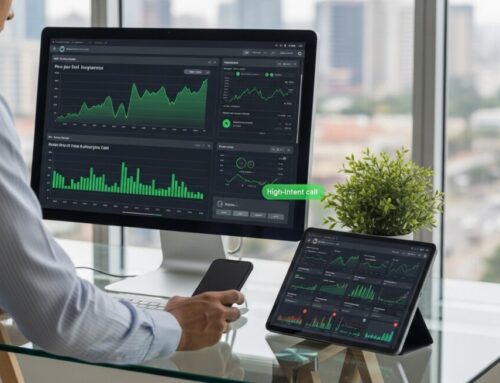


Scaling a Lead Exchange Platform for Millions of Daily Pings
In the high-stakes world of real-time lead generation, a platform’s ability to scale is not just a feature, it is the entire business. The core mechanism, the dynamic ping, is a deceptively simple concept with immense technical complexity. Each ping represents a potential customer, a live signal from a buyer that must be matched, routed, and sold to the most appropriate seller in milliseconds. When your platform’s daily volume grows from thousands to millions of these dynamic events, every architectural decision is magnified. Latency becomes revenue leakage, and downtime translates directly to lost opportunities. This article delves into the critical strategies and architectural patterns required to build a lead exchange that is not only fast but also resilient, cost-effective, and capable of handling exponential growth without missing a beat.
Understanding the Core Challenge: The Anatomy of a Dynamic Ping
Before tackling scale, one must fully understand the transaction. A dynamic ping, often called a “ping tree” or “ping post” event, is a real-time auction for a consumer lead. When a user submits their information on a website (for example, for an auto insurance quote), that data is packaged into a ping and simultaneously sent to multiple buyers (insurance carriers or agencies) via the exchange platform. Each buyer has a brief window, often 300-500 milliseconds, to respond with a bid. The platform must collect these bids, apply business logic (like filtering for geographic eligibility), select the winner, and return the winning buyer’s information to the source, all before the user navigates away from the page. This process involves several distinct phases: ingestion, validation, distribution, aggregation, decisioning, and response. At a scale of millions per day, this translates to a sustained, unpredictable load of hundreds of transactions per second, each requiring state management, network calls, and data persistence.
Architectural Foundations for Massive Scale
The transition from a monolithic application to a distributed, microservices-based architecture is non-negotiable for handling this load. The goal is to decompose the ping journey into independent, scalable services. A robust ingestion service acts as the front door, built to absorb traffic spikes using load balancers and autoscaling groups. It should perform minimal validation (checking for malformed data) before placing the ping into a high-throughput, durable message queue like Apache Kafka or Amazon Kinesis. This queue decouples the ingestion layer from the processing layer, ensuring that sudden surges in inbound pings do not overwhelm the core logic.
From the queue, specialized worker services consume the pings. These services are stateless, allowing you to scale them horizontally by simply adding more instances as queue depth increases. Their primary job is to enrich the lead data, apply initial filters, and most critically, fan out the request to downstream buyers. This fan-out is where parallelism is key. Instead of calling buyers sequentially, the platform must initiate all buyer API calls concurrently. Implementing a circuit breaker pattern for each buyer endpoint is crucial to prevent a single slow or failing buyer from causing a timeout for the entire transaction. The responses are then aggregated by a decisioning service. This service applies the final business rules, selects the highest bidder (or the first acceptable bid, depending on the model), and records the transaction. A separate, asynchronous service can then handle post-back notifications to the source and the winning buyer.
Data Management and State at High Velocity
Managing state and data for millions of ephemeral transactions requires careful database selection. The primary transaction log, recording every ping and its outcome, should be written to a database optimized for high write throughput, such as a NoSQL database like Cassandra or a time-series database. Relational databases can become a bottleneck for the core transaction flow. However, they are still valuable for serving configuration data, such as buyer rules, filters, and pricing tiers, to the processing services. This configuration data should be cached in-memory using a distributed cache like Redis or Memcached to avoid hitting the database on every transaction. Redis is particularly powerful in this context, as it can also be used for real-time rate limiting, tracking request counts per buyer or source, and even as a secondary message broker for inter-service communication.
Data consistency models must be chosen wisely. For the auction process, eventual consistency is often acceptable. The critical path is returning a winning buyer ID to the consumer. The logging of the full bid data and the financial settlement can happen seconds later without impacting the user experience. Designing with this in mind allows you to use faster, more scalable persistence mechanisms for the critical path and more robust, analytical databases for the settlement and reporting pipelines.
Optimizing Performance and Ensuring Resilience
Performance optimization at this scale is a multi-front effort. Every millisecond saved in the processing pipeline increases capacity and improves buyer response rates. Key strategies include:
- Geographic Distribution: Deploying processing nodes in multiple cloud regions close to both your traffic sources and your major buyers to minimize network latency.
- Connection Pooling: Maintaining persistent, warm HTTP/2 connections to buyer endpoints to avoid the overhead of TCP handshakes and SSL negotiations for every ping.
- Efficient Serialization: Using binary protocols like Protocol Buffers or Avro for internal service communication, which are faster and smaller than JSON.
- Asynchronous Everything: Ensuring that no part of the core transaction loop blocks on I/O operations, leveraging non-blocking frameworks and programming models.
Resilience is equally critical. A platform handling millions of dollars in transactions daily cannot afford extended outages. Implementing comprehensive monitoring with tools like Prometheus and Grafana is essential to track key metrics: ping volume, latency percentiles (P50, P95, P99), error rates per buyer and service, and queue depths. Automated alerts should trigger scaling policies or notify engineers of anomalies. Chaos engineering, the practice of intentionally injecting failures like terminating instances or slowing networks in a staging environment, helps validate that the system gracefully degrades rather than catastrophically fails. For instance, if a key buyer’s API goes down, the circuit breaker should open, and the platform should seamlessly auction the lead among the remaining healthy buyers, a process similar to ensuring reliable lead flow in other high-volume sectors like Medicare insurance leads and live calls.
Cost Management and Future-Proofing
Scaling to millions of transactions can become prohibitively expensive without cost controls. A primary cost driver is data transfer, especially egress fees from cloud providers to the internet (to buyer endpoints). Optimizing payload size and negotiating peering agreements can help. Compute costs are managed through effective autoscaling, ensuring you are not paying for idle capacity. Using spot instances or preemptible VMs for non-critical, stateless worker services can yield significant savings. Furthermore, implementing smart filtering at the ingestion layer can prevent paying to process invalid or low-quality pings that have no chance of being sold.
Future-proofing the architecture involves planning for not just more volume, but new types of volume. The platform should be designed to easily onboard new verticals (e.g., moving from auto insurance to home loans) with different data schemas and business rules without rewriting core services. An API-first design, where internal services communicate via well-defined contracts, facilitates this. As machine learning becomes more prevalent, the architecture should allow for the integration of real-time scoring models that can predict lead quality or optimal routing, adding another layer of decisioning intelligence to the millisecond-scale auction.
Building a lead exchange that reliably handles millions of dynamic pings daily is a continuous engineering challenge that blends software architecture, data engineering, and DevOps principles. Success is measured in consistent sub-second latency, 99.99% uptime, and the ability to turn every legitimate consumer signal into a monetizable transaction. By investing in a decoupled, event-driven architecture, prioritizing resilience alongside raw speed, and implementing granular cost controls, platforms can scale to meet the demands of the global real-time lead generation market, ensuring they capture value at every step of the exponential growth curve.